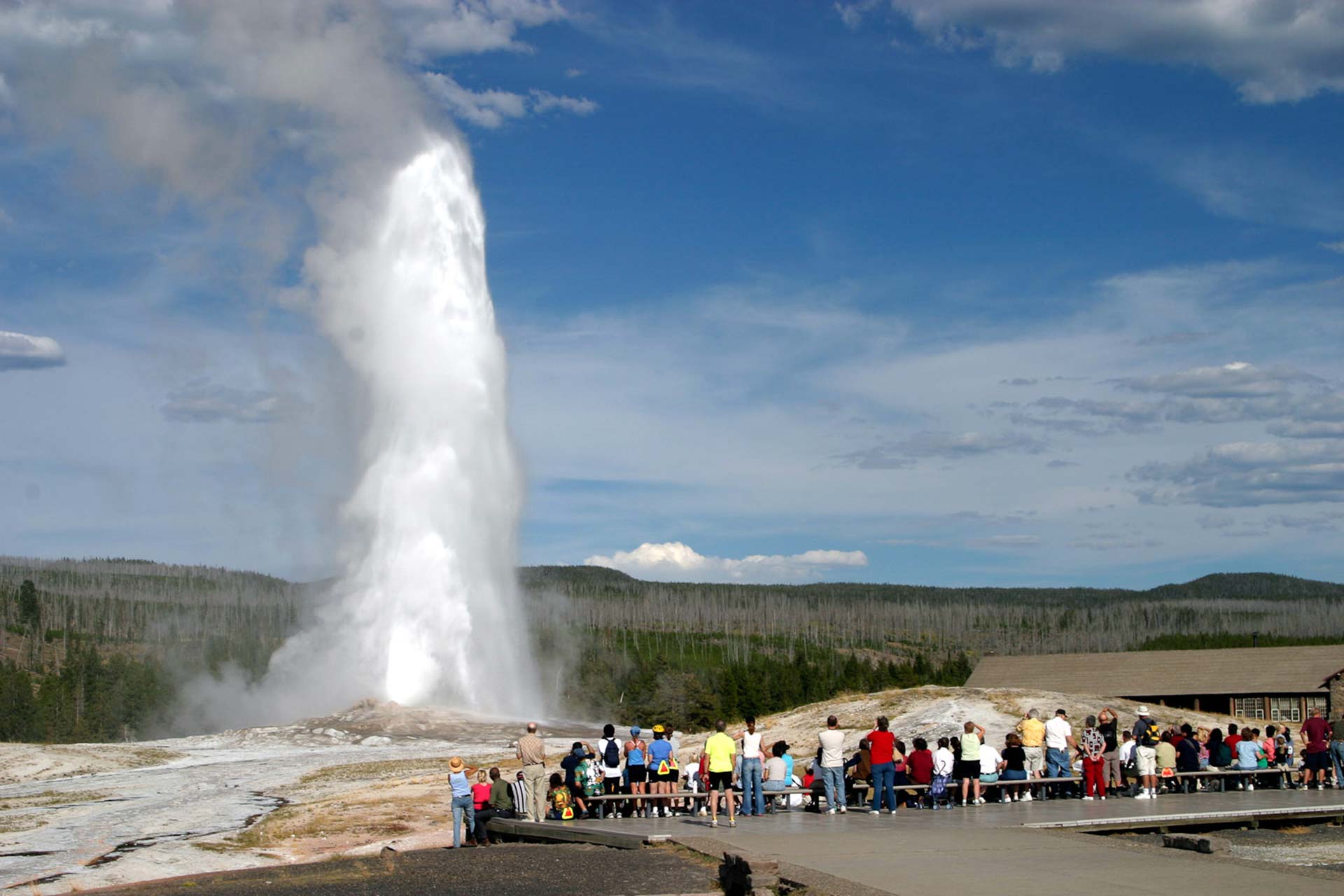
America’s national parks draw visitors from around the world. Since the 1980s, the number of total visitors to National Park Service units has been trending up, with a brief decline in 2020 due to the coronavirus pandemic. While visitation grew in 2022 in many national parks, several others were disrupted or temporarily closed due to natural disasters. Disasters like floods and wildfires affect the national parks and the communities whose economies depend on them.
In the visualization below, see the trends for every National Park Service unit in all 50 states.
Subscribe to our newsletter!
Visitors spend money and create jobs
Visitors to national parks and other nearby federal lands contribute billions to regional economies while creating hundreds of thousands of private sector jobs. In turn, the labor income from these jobs spurs more economic growth in nearby communities. The National Park Service and U.S. Geological Survey track visitor spending effects annually, displayed in the visualization below.
Broader economic impact of national parks
The economic benefits of national parks extend beyond tourism. In today’s economy, the greatest value of natural amenities and recreation opportunities often lies in the ability of protected lands to attract and retain residents, entrepreneurs, businesses, and the growing number of retirees who relocate for improved quality of life.
However, the growth spurred by national parks and other protected federal lands can have trade-offs. In rapidly growing amenity destinations, housing can become unaffordable. Maintaining infrastructure such as roads, water, and recreation amenities can be challenging for towns with a population dwarfed by seasonal visitors. Trailheads, campsites, and outdoor spaces can become crowded and overused. Yet outdoor recreation presents an opportunity for many communities to diversify their economies and move away from dependence on oil and gas development, timber harvest, mining, and other specialized industries.
Additional resources
Headwaters Economics has developed online tools and documents to shed light on local economies and the role of protected public lands:
- Socioeconomic Profiles: The Economic Profile System is a free, easy-to-use software that provides detailed, customizable reports at the community, county, or state level.
- National Monuments: Case studies and reports on the economic performance of communities adjacent to western national monuments.
- Public Land Ownership in the United States: Interactive map and reports showing the share of public lands in every U.S. county and state.
- Federal Lands in the West: Study showing that rural counties in the West with more federal lands or protected federal lands performed better on average than their peers with less federal lands or protected federal lands in four key economic measures.
- People and Public Lands: Collection of essays written by some of the most prominent and respected scholars of public lands that addresses questions related to the economic impact of America’s public lands.
- Protected Lands and Income: Study and visualization showing the amount of per capita income explained by protected federal lands for each county in the non-metropolitan western United States.
- West Is Best: Report finds that the West’s popular national parks, monuments, wilderness areas, and other public lands offer its growing high-tech and services industries a competitive advantage.
- The Value of Public Lands: Web post contains links to numerous reports, case studies, bibliographies, tools, and research concerning the value of western protected public lands.
Methods & Data Sources
This post was updated in September 2023 from an earlier version. The visualizations use data from the National Park Service/USGS Visitor Spending Effects report series. View the National Park Service’s data tool and the 2022 visitor spending effects report.
These visualizations include National Park Service units in the 50 U.S. States and the District of Columbia but not NPS Units in Puerto Rico, American Samoa, Guam, and other U.S. Territories.
How to cite this research
Flyr M and L. Koontz. 2023. 2022 national park visitor spending effects: Economic contributions to local communities, states, and the nation. Natural Resource Report NPS/NRSS/EQD/NRR—2023/2551. National Park Service, Fort Collins, Colorado. https://doi.org/10.36967/2299764
As reported by Headwaters Economics at https://headwaterseconomics.org/public-lands/protected-lands/economic-impact-of-national-parks.