The local economic implications of Lower Snake River dam removal
Impacts and Opportunities for Nez Perce County, ID, and Asotin County, WA
Photo courtesy EcoFlight
A far-reaching debate is underway about the possibility of removing four dams on the Lower Snake River near the border of Idaho and Washington. Built to support transportation, electricity generation, and irrigation, the dams have also disrupted natural water flows, obstructed salmon populations, and affected Tribal communities. As the local economy and energy systems evolve, many are questioning whether it is time to retire the dams and adopt new solutions.
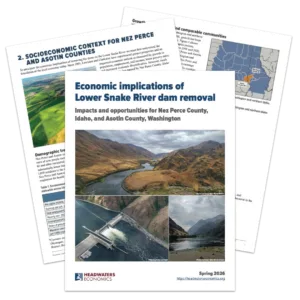
Headwaters Economics, in partnership with Idaho Rivers United, analyzed how dam removal could affect the economies of Lewiston and Clarkston in Nez Perce County, Idaho, and Asotin County, Washington. The full report, “Economic Implications of Lower Snake River Dam Removal,” describes how dam removal would not significantly impact population growth, employment, income, energy generation, and locally significant economic sectors in these places. The findings challenge many common assumptions about the dams’ role in local economies.
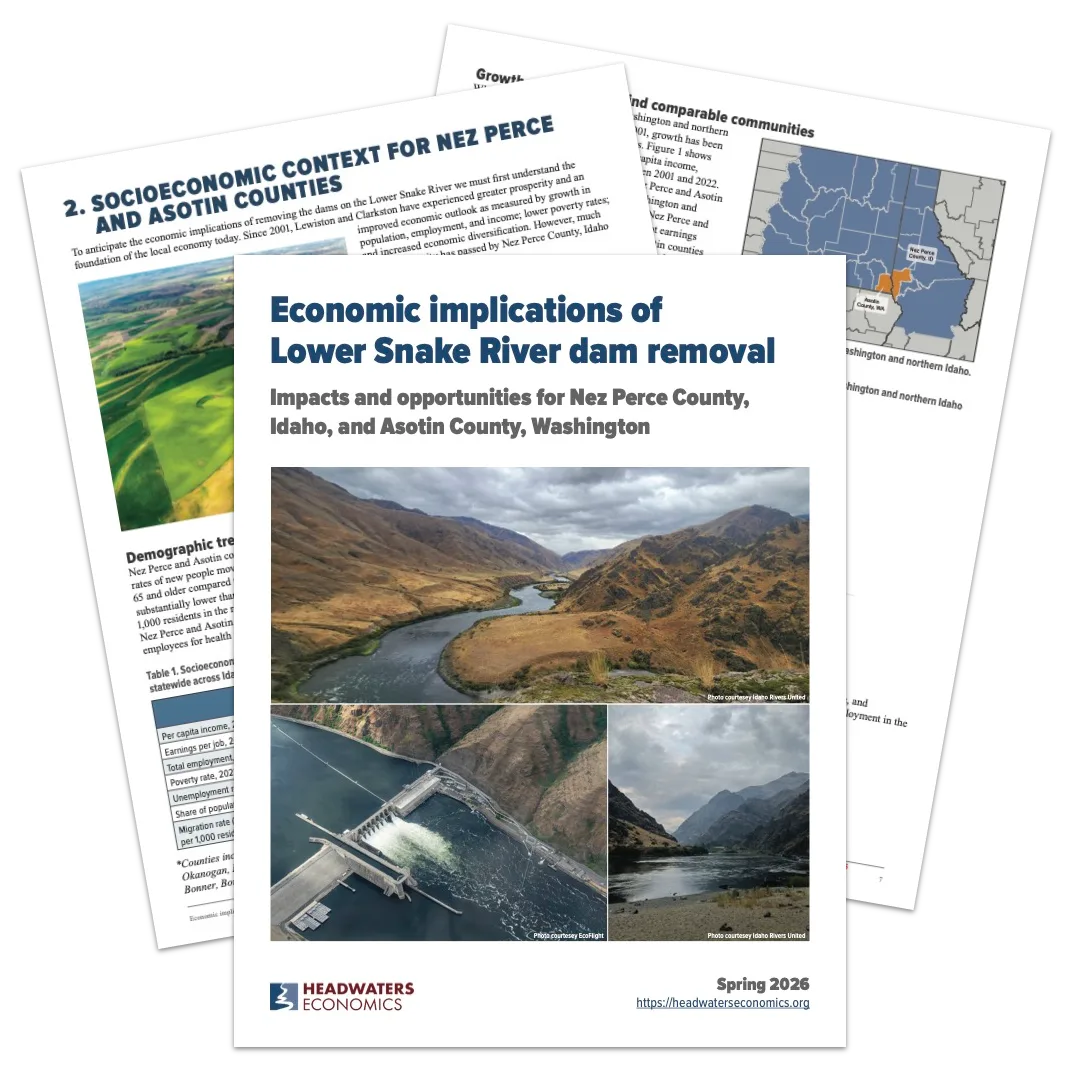
Photo courtesy Idaho Rivers United
The economies of Nez Perce County and Asotin County are lagging
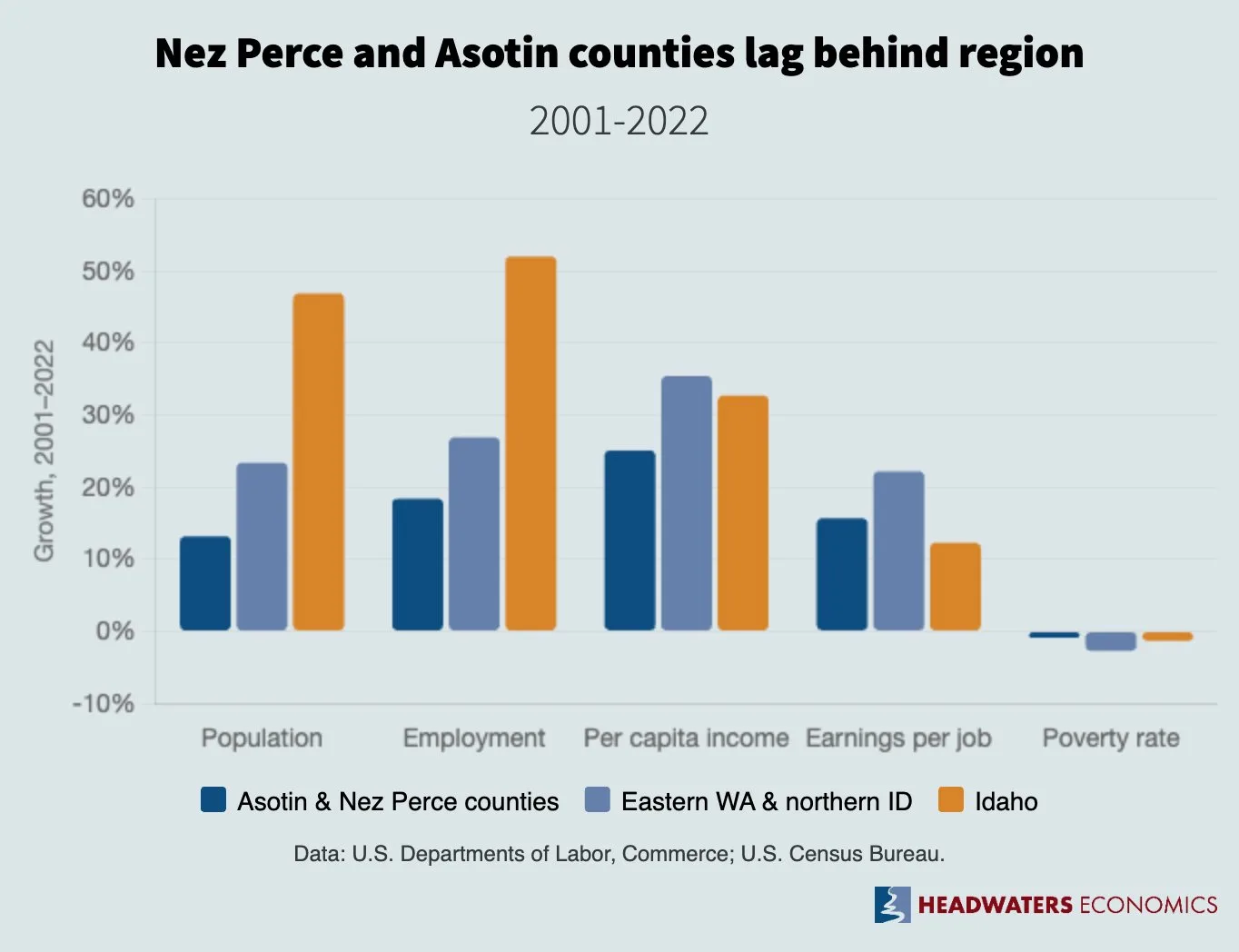
The analysis shows that despite broader prosperity across eastern Washington and northern Idaho since 2001, Nez Perce and Asotin counties have fallen behind on nearly every key economic measure: population growth, employment, per capita income, and poverty reduction. The region is aging rapidly and attracts new residents at less than half the rate of the broader region. These trends point to long-term workforce challenges for these counties, independent of any decision about the dams.
73
%
of population growth (2010–2024) came from residents 65+
5.9
vs.
10.2
new residents per 1,000 vs. 10.2 in the broader region
Nez Perce and Asotin counties lag behind region
2001-2022

The Lower Snake River dams are not driving the local economy
The largest employers in Nez Perce and Asotin counties—government, healthcare, and manufacturing—have no meaningful connection to the dams and together account for 42% of all jobs in the region. The sectors most tied to dam infrastructure (farming, utilities, transportation, and agricultural services) have shown no significant growth for two decades. Some federal jobs are tied to dam operations but account for only 1% of the area’s workforce.
Top employers are unrelated to dams
Government
5,356
employees
Health Care
5,321
employees
Manufacturing
5,244
employees
Retail
4,330
employees
Most employment is not connected to dam-related sectors
Nez Perce and Asotin counties, 2022
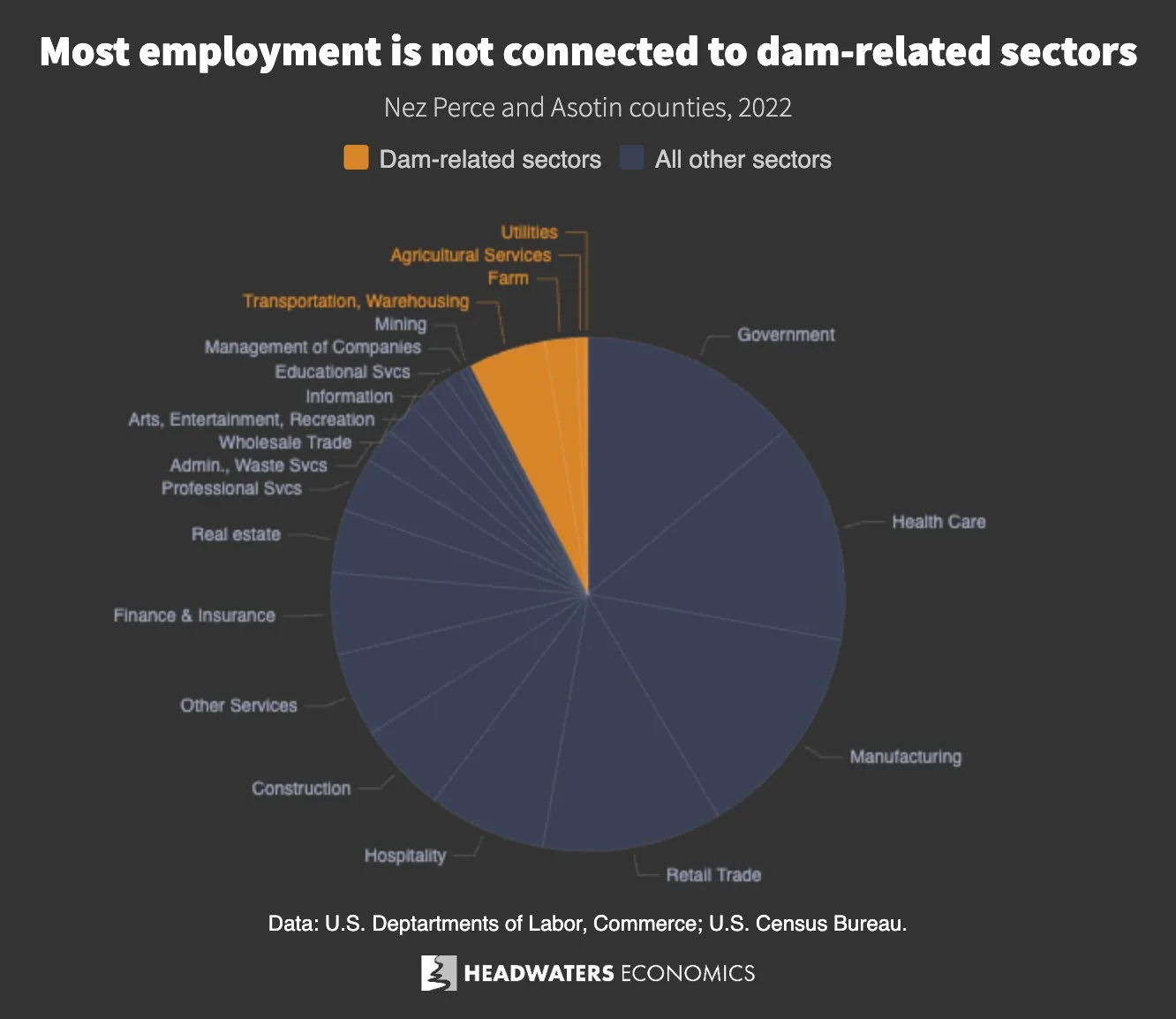

Photo courtesy EcoFlight
Subscribe to our newsletter!
Photo courtesy EcoFlight
Photo courtesy Idaho Rivers United
Dam removal does not disrupt local economies
A statistical analysis of 24 dam removal projects across the United States found no significant negative effects on employment, population, or earnings per job in surrounding communities following removal. In fact, dam removal was associated with modest improvements in per capita income and non-labor income growth. Forecasts for Nez Perce and Asotin counties suggest dam removal would produce outcomes comparable to—or slightly better than—leaving the dams in place.
24
comparable dam removals studied nationwide
+
2
%
higher per capita income if dams are removed
+
8
%
higher non-labor income if dams are removed
Forecasts for economic conditions after dam removal
Nez Perce and Asotin counties, 2020-2030

Electricity replacement is underway
The four dams combined generate roughly 700 average megawatts annually—about 10–12% of the energy supply of the Bonneville Power Administration (BPA), the federal entity that distributes electricity across the Pacific Northwest. While substantial, this scale of generation is being matched by projects currently under construction nationwide (wind, solar, nuclear). Estimated electricity rate increases are modest (~$1–2/month), and must be weighed against growing dam maintenance, capital upgrade, and fish and wildlife mitigation costs that are already built into BPA electricity rates. Moreover, revenues from the dams currently flow to the federal government, but renewable projects would generate tax revenue for local governments and lease payments for landowners.
Transition planning and investment are essential
Energy infrastructure transitions are cultural as well as economic shifts. Communities that have navigated them successfully planned early, built on existing local strengths, and had state and federal support to make investments in workforce and economic diversification. Strategies for local leaders in Nez Perce and Asotin counties could include:
- A regional transition endowment providing stable, long-term funding for local governments
- Community-owned renewable energy projects that generate local tax revenue and lease payments for landowners
- Residential and commercial energy efficiency programs that reduce energy costs while creating local jobs
Photo courtesy EcoFlight
Data sources and methods
Socioeconomic context
To describe current economic conditions in the Lower Snake River region, we compiled socioeconomic indicators for Nez Perce County, Idaho, and Asotin County, Washington, and compared them to the broader region of eastern Washington and northern Idaho, as well as statewide across Idaho.
We examined the following economic indicators:
- Population and population growth by age group
- Total employment and employment by sector
- Per capita income and earnings per job
- Poverty rate
- Unemployment rate
- Migration rate (average number of new residents per 1,000 existing residents)
Data were drawn from the following sources:
- U.S. Department of Labor, Bureau of Labor Statistics, Quarterly Census of Employment and Wages
- U.S. Department of Commerce, Bureau of Economic Analysis, Regional Economic Accounts
- U.S. Census Bureau, American Community Survey (poverty rate, migration rate)
- U.S. Bureau of Labor Statistics, Local Area Unemployment Statistics
We report employment data through 2022, the most recent year for which complete county-level data are available. We report all dollar values in 2024 dollars.
Comparison dam removal projects
To assess the economic implications of removing the Lower Snake River dams, we identified 24 dam removal projects from across the United States for comparison. We selected projects that met each of the following criteria:
- The dam had been used primarily for hydropower, agricultural water supply, or navigation — uses comparable to the Lower Snake River dams.
- The dam was among the larger removals in its region, reflecting the scale of the Lower Snake River projects.
- The dam was removed in 2021 or earlier, providing at least one year of post-removal economic data.
- The removal represented a geographic range of communities and regional contexts.
- For each dam removal project, we identified the county or counties adjacent to the dam site and compiled county-level economic data before and after removals.
We use data spanning 1970 through 2022.
Statistical model
We developed a panel model to evaluate whether dam removal is associated with changes in the growth rates of key economic indicators in surrounding communities. The model accounts for temporal trends affecting all dam removal regions and for unobserved differences between dam regions, and it identifies whether removal is associated with meaningful positive or negative effects on local economic performance.
We specified growth for each economic indicator as a five-year moving average to smooth short-term variation and capture longer-term trends. Economic indicators examined in the model include population, total employment, earnings per job, labor earnings, non-labor income, per capita income, farming employment, travel and tourism employment, and timber employment.
Using the results of this model, we estimated forecasted economic conditions for Nez Perce and Asotin counties under two scenarios: dam removal beginning in 2026, and dams remaining in place. Forecasts extend through 2030.
For complete model specification and parameter estimates, see Appendix A of the full report.
Full report
For complete methodology, data sources, and statistical results, download the full report: Economic Implications of Lower Snake River Dam Removal.