
2025 Regional Tribal Emergency Management Summit
Hosted by

Highlights from 2025
The third annual Regional Tribal Emergency Management Summit took place from May 27-29, 2024, in Rapid City, South Dakota. The 100 participants included tribal emergency managers and personnel engaged in emergency response from Tribes in Minnesota, Montana, Nebraska, North Dakota, and South Dakota. Professionals with 15 tribal affiliations gathered to make collective progress on topics including disaster response, leadership, search and rescue, and access to resources.
Want to see overviews and resources from previous summits?
2025 Session Overviews & Resources
We recorded the full presentation/workshop for four of our sessions this year. Scroll or click here to see summaries of the the other sessions held at this year’s event.
Leadership during uncertainty
Joshua Arce | Partnership With Native Americans
Joshua joined PWNA as president & CEO in January 2020, our 30th year of serving Indian country. A citizen of the Prairie Band Potawatomi Nation, he has more than 20 years’ experience in education management, social work, and business development. Most recently, he served as Chief Information Officer of Haskell Indian Nations University, advancing their IT infrastructure and services to better meet their mission. Other public sector experience includes Tribal law and governance; after-school, youth, foster care, and housing programs for low-income families; and diversity and inclusion.
In this session, participants explored strategies to encourage leaders to change challenging times into opportunities. Topics included; Redefining Success, Work-Life Balance Myths, and Overcoming Imposter Syndrome. This session provided strategies for the Big Three of Prioritization and discussed Why Narratives Matter. Participants left recharged, renewed, and ready to tackle whatever comes next!
Resources:
- Website: Partnership With Native Americans
Housing solutions for hazard risk reduction
Ryan Handy & Patty Hernandez | Headwaters Economics
Ryan Maye Handy is a planner whose work has included development permitting, workshop facilitation, and running technical assistance programs to help communities plan for the effects of a changing climate.
Her expertise supports Headwaters Economics’ Community Planning Assistance for Wildfire program, which has helped more than 80 communities across the country increase their wildfire resilience. In
addition to her strengths as a planner, Ryan spent more than a decade as a journalist working for newspapers in Texas and Colorado. Connecting with people, learning about their worldviews and challenges, and helping them live well within their chosen landscapes are guiding principles in her work.
Patty Hernandez is co-founder and Executive Director of Headwaters Economics, a Montana based nonprofit. Patty has 20 years of experience building programs that help rural communities reduce hazard risks and create economic opportunity. Under Patty’s leadership, Headwaters Economics works to use economics to improve local outcomes. Patty has built effective working partnerships with federal agencies, state and local governments, professional organizations, nonprofits, and academic institutions to develop solutions that help communities adapt to a changing world.
Staff from Headwaters Economics led an interactive session to discuss ideas about practical and affordable ways to improve Tribal housing. Topics included weatherization and disaster risk reduction practices that can protect homes from water, wind, and wildfires. This session included opportunities to identify priority projects and partnerships for near-term implementation.
Resources:
- Website: Community Planning Assistance for Wildfire (CPAW) & Headwaters Economics
- Handouts: FloodWise & CPAW
Guide to Floodplain management
Bill Brown | Association of State Floodplain Managers (ASFPM)
Bill Brown is the senior project manager and past Director of ASFPM’s Flood Science Center. He studied the technical, biologic, social, and economic aspects of flood science. Prior to his tenure with ASFPM, he was hired as the inaugural stormwater executive manager for the city of Arlington, Texas where he directed the development of a comprehensive stormwater and floodplain management program. Over his 30-plus year career, Bill has worked in the private sector, municipal and county stormwater and floodplain management programs, academia, and not-for-profit organizations focused on reducing flood risk while improving the environment.
This session provided an overview of the new “Emergency Manager’s Quick Guide To Floodplain Management”, which introduces basic concepts of floodplain management and flood mitigation. Topics included understanding flood risk, how to read a flood map, basic floodplain management regulations, and examples of flood protection and potential funding sources.
Resources:
- Website: Association of State Floodplain Managers
- Presentation: PDF
Housing solutions for hazard risk reduction
Shelby Lorenzo-Homer | Mako Sica K9 Search & Rescue
Deanna Prue | Great Plains Tribal Leaders Health Board
Yá’át’ééh, I am Shelby Lorenzo-Homer. I am of the Diné Nation originally from Farmington, NM currently residing in Mission, SD. I’m the founder of Mako Sica K9 Search and Rescue. I’m currently a member of NM search and rescue, 4 Corners K9 Search and Rescue, National Association of Search and Rescue, and Wolfpack working dogs. I specialize in the fundamentals for producing detection K9s in wilderness air scent live find, human remains detection also known as cadaver disciplines. I work closely with MMIW, MMIP, MMIR organizations to assist families needing search and rescue resources throughout the midwest.
Deanna Prue is a proud member of the Rosebud Sioux Tribe. She has been the Program Manager of the Trauma and Violence Prevention Initiative at Great Plains Tribal Leaders Health Board for four years. In addition to that she is the Missing and Murdered Indigenous People Task Force Leader for the Great Plains Tribal Leaders Health Board.
This session covered steps to take when a relative goes missing, how to navigate the justice system, and support for survivors and families. The presenters shared search and rescue resources and insights about how to adapt search and rescue criteria to fit cultural sensitivities along with our MMIP crisis.
Resources:
- Website: Great Plains Tribal Leaders Health Board
- Mako Sica K9 social media: Facebook & Instagram
Tribal Emergency Leader Panel
This panel discussed Traditional Indigenous knowledge and disaster resilience leadership. The panelists shared stories of cultural kinship and healing relationships, grassroots Tribal programs, collective approaches to learning, volunteer building, and training teams of self-suficient responders within Tribal Nations to respond during disasters. These panelists are emergency managers who have dedicated their lives’ work to honoring and protecting the people, unci maka, mni wakan, wamanica/wamakaskan, taku wakan skan skan all beings.
Below you will find overviews of the other sessions along with links to resources from this year’s summit.
Building resilient youth in our communities
Diane Sharp | Adler Disaster Consulting
Dr. Diane Sharp (Oglala Lakota) specializes in suicide prevention and wellness on Pine Ridge Reservation and in tribal communities across the U.S. She holds a doctorate in Community Care and Trauma Counseling and a MA in Crisis Response and Trauma Counseling. She holds a doctorate in Community Care and Trauma Counseling and MA degree in Crisis Response and Trauma.
Attendees gained knowledge of effective strategies to empower youth with leadership skills and emergency preparedness training, ensuring they play an active role and stay safe from predatory behavior during emergencies. Participants learned how to incorporate culturally relevant approaches to engage youth in disaster planning, fostering stronger intergenerational connections and knowledge-sharing.
Resources:
GIS in Indian Country: Resources & Guidance
Garet Couch | National Tribal Geographic Information Support Center
Garet Couch, GISP, is a citizen of the Shawnee Tribe and is President/CEO of the National Tribal
Geographic Information Support Center (NTGISC), also known as Tribal GIS, a nonprofit organization with an objective to provide assistance to Native American tribal governments and Native American organizations regarding geographic information technology. NTGISC’s work is helping people who are responsible for stewardship of lands, resources, and people’s health and well-being make wise decisions.
This session provided an overview of GIS in Indian Country, including how other Tribal Communities are applying GIS Technologies. The session covered GIS resources available to Tribal Governments including access to software, technical assistance, and training opportunities. Garet gave guidance on best practices to use GIS when responding to emergencies and pre-disaster planning in Indian Country.
Resources:
Sovereign Data, Stronger Immunity: The Fight Against Outbreaks
Sarah Shewbrooks | Great Plains Tribal Leaders Health Board
Sarah Shewbrooks serves as an Epidemiologist and Data Products Manager at the Great Plains Tribal Epidemiology Center within the larger Great Plains Tribal Leaders’ Health Board in Rapid City, South Dakota. Sarah has both participated in and led efforts responding to the Missing and Murdered Indigenous Women, Girls, Transgendered, and Two Spirit (MMIWGT2) crisis and suicide prevention for the 18 tribal Presenters | 2communities she serves within North Dakota, South Dakota, Iowa, and Nebraska. She also serves on her organization’s Intimate Partner Violence and MMIWGT2 task force.
Learn about the role of data and tribal data sovereignty in public health and its impact on recent and emerging disease outbreaks.
Resources:
Engaging with the Red Cross
Richard Smith | Red Cross
Richard Smith is the Executive Director of the Red Cross in Central and Western South Dakota. Richard brings experience from previous roles at TWA/AA Airlines and has a robust skill set that includes program management, strategic planning, budgets, training, and more.
In this session, attendees gained insights into the Red Cross programs and resources that are available to them. They learned how to access Red Cross resources for all ages, for veterans, and after disasters. Attendees learned how to request Red Cross trainings for their community members.
Resources:
Structural Fires: Are you prepared?
TJ Plume | Alpha One
TJ Plume serves as the CEO of Plume Inc. and the Fire Chief of Alpha One, a subsidiary of Plume Inc. TJ
holds a Bachelor of Arts in Tribal Law. Alpha One Fire & Rescue is in the Wounded Knee District in the Crazy Horse community on the Pine Ridge Indian Reservation. Alpha One provides wildland and structural fire protection in the communities of Wounded Knee, Porcupine, Sharps Corner, Rockyford & Manderson.
This session helped attendees gain knowledge to better equip and plan for structural fires. The session showed how fast structural fires can spread in newer homes versus older homes, and the potential for structural fire injuries and fatalities.
Resources:
- Website: Alpha One Fire & Rescue
Healing from Trauma and Resilience Through Culture and Strength
Leon Leader Charge | SAMHSA Tribal Training and Technical Assistance
Leon Leader Charge (Sicangu/Oglala Lakota)works nationwide with Indigenous communities in the realm of prevention. He utilizes evidence based best practices and traditional indigenous healing methods that are universal to all nations. The Tribal Training and Technical Assistance Center provides American Indian and Alaska Native communities with tools for preventing mental and substance use disorders and suicide and promoting mental health.
Traumatic stress plays a role in our lives and the work we do. This session examined healing-informed approaches to wellness and examine western approaches to healing along traditional Indigenous healing methods. Participants learned how they can mitigate the impacts of mental health disparities on individuals and communities.
Resources:
Highlights from 2024
The second annual Regional Tribal Emergency Management Summit took place from June 18 to 20, 2024, in Oacoma, South Dakota. The 60 participants included tribal emergency managers and personnel engaged in emergency response from Tribes in Kansas, Montana, Nebraska, North Dakota, and South Dakota. Professionals with 15 tribal affiliations gathered to make collective progress on topics including hazard mitigation planning, leadership and youth programs, and access to resources.
See the latest summit
Hosted by
Session Overviews & Resources
Response & Recovery
Search & Rescue
Shelby Lorenzo-Homer | Mako Sica K9 Search and Rescue
Yá’át’ééh, I am Shelby Lorenzo-Homer. I am of the Diné Nation originally from Farmington, NM currently residing in Mission, SD. I’m the founder of Mako Sica K9 Search and Rescue. I’m currently a member of NM search and rescue, 4 Corners K9 Search and Rescue, National Association of Search and Rescue, and Wolfpack working dogs. I specialize in the fundamentals for producing detection K9s in wilderness air scent live find, human remains detection also known as cadaver disciplines. I work closely with MMIW, MMIP, MMIR organizations to assist families needing search and rescue resources throughout the midwest.
Shelby Homer of Mako Sica K9 Search and Rescue discussed how Search and Rescue resources have become needed more than ever during the last 15+ years on Tribal lands. Insight on how missions have been conducted included improvements and adaptations for Search and Rescue criteria to fit Tribal cultural sensitivities along with the MMIP crisis.
Resources:
- Social media: Facebook & Instagram
- Presentation: Search & Rescue Introduction
Searching for our relatives: Practicing the art of being a good relative
Lily Mendoza | The Red Ribbon Skirt Society
Lily Mendoza is a member of the Cheyenne River Sioux Tribe. In 2016 Lily co-founded the Red Ribbon Skirt Society, a grassroots collective dedicated to confronting the issue of missing and murdered indigenous women, children, and two-spirit and transgender people. The society works to advocate, support, give voice to, and stand with families whose lives have been affected by a missing or murdered loved one.
The session included information about the art of compassionate listening and being a good relative, including discussion of Joseph M. Marshall III’s book, “Sing for the Red Dress.” Participants shared experiences engaging with families of MMIW victims and healing together as a community.
Resources:
- Social Media: Facebook
- Website: Red Ribbon Skirt Society
- Film: “Bring Her Home”
Developing medical & tactical response teams on the reservation
Alan Blackburn | HS Teacher at Marty Indian School, CERT Instructor, and Sentinel Agent
Alan Blackburn first became a firefighter in 1988. Since then, he has worked for four fire departments as a firefighter and an EMT. He is currently an SD state-certified firefighter for the Lake Andes Fire Department and the program manager for the Yankton Sioux Community Emergency Response Team (CERT). He also teaches a high school Teen CERT class at Marty Indian School and is currently developing an active shooter response team for the Lake Andes Fire Department and the Marty Indian School. Alan started the Sentinel Program at Marty Indian School where he and another teacher, certified by the state law enforcement academy as school sentinels, carry concealed weapons on campus for active shooter and threat response.
Due to delayed response times from emergency personnel on the reservations we need to develop our own response teams. Alan shared how he built a disaster response team and an armed school and tribal sentinel program. He also explained his Teen CERT program where he trains teens in basic disaster response as a high school elective.
Resources:
- Video: Teen CERT and the Sentinel program
- Program: School Sentinel Training
- Program: FEMA CERT
Toolkit: Community Organizations for Assisting Disasters (COAD)
Lisa Adler | Adler Disaster Consulting
Lisa Adler, Adler Disaster Consulting CEO, has worked in the social services field since 1996 providing services to families throughout South Dakota and surrounding states, including Native American Reservations. She has developed, implemented, and certified staff in trainings for Residential Group and Residential Treatment, LPC MH Counselor trainings, Community Based trainings, and South Dakota Voluntary Organizations Active in Disaster (SD VOAD) trainings. In addition, she is a certified trainer in Safe Crisis Management, Critical Incident Stress Debriefing, Critical Incident Stress Management, and Resiliency. Lisa has been an active member of SD VOAD since 2003 and served as the President of SD VOAD from 2011 to 2018. Adler Disaster Consulting services has offered trainings and mentoring/coaching opportunities that are built on National VOAD Points of Consensus, collaboration of best practice standards and years of experience that are tailored to specific community needs in emergency preparedness, mitigation, response, and recovery.
This training used the COAD Toolkit to provide an overview of community engagement during preparation, response, and recovery from disasters. The Toolkit assists Tribal Nations in establishing Community Organizations Active in Disaster (COAD) in a way that can be modified to fit the needs and culture of Tribal communities.
Resources:
- Website: We Are Warriors Emergency Operations Center Program
- Handout: Tribal COAD Summary
- Handout: Tribal COAD Toolkit
Grants & Resources
Improving the safety of manufactured homes: Flood & wildfire risk reduction
Patty Hernandez | Headwaters Economics
Patty Hernandez is co-founder and Executive Director of Headwaters Economics, a Montana based nonprofit. Patty has 20 years of experience building programs that help rural communities reduce hazard risks and create economic opportunity. Under Patty’s leadership, Headwaters Economics works to use economics to improve local outcomes. Patty has built effective working partnerships with federal agencies, state and local governments, professional organizations, nonprofits, and academic institutions to develop solutions that help communities adapt to a changing world.
Mobile and manufactured homes are a critical source of affordable housing, but they are also more susceptible to damage during floods and wildfires. This session encouraged group discussion about improving safety through low-cost retrofits and actions that can help protect mobile homes and residents from natural disasters.
Resources:
- Handout: FloodWise recommendations for mobile homes
- Handout: CPAW recommendations for mobile homes
- Program info: FloodWise Community Assistance
- Program info: Community Planning Assistance for Wildfire
PWNA Material Services & Long Term Solutions
Amy Dooley | Partnership With Native Americans
Amy Dooley is the Program Partner Support Specialist for Partnership With Native Americans in the Northern Plains region since August 2021. Her father was in the Air Force, so she spent most of her childhood on or near Ellsworth Air Force Base. In high school, Amy’s family relocated to the Springfield, Missouri area and she graduated high school in 2002 and spent a few more years in Missouri with family, as well as having her beautiful daughter. She and her daughter relocated to the Black Hills in 2011, as the hills have always been home to her. When the opportunity to be a part of PWNA came about, Amy didn’t hesitate. She has learned so much and continues to learn more every day. Amy enjoys spending time with her daughter, family, and friends. Traveling, going to concerts and hiking are some of her favorite things to do outside of work. She has met so many amazing people through PWNA, and looks forward to continuing to build relationships with the programs and communities PWNA partners with and serves!
This session provided an overview of the services Partnership With Native Americans (PWNA) offers through their Material Services arm. During the session, Amy Dooley, PWNAs Program Partner Support Specialist, shared slides and handouts and help attendees understand how they can apply for PWNAs Material Services.
Resources:
- Website: Partnership With Native Americans
- Contact info: PWNA Plains Office
- Presentation: PWNA Materials Services and Long Term Solutions
Accessing wildfire mitigation funding
Doug Green | Headwaters Economics
Doug manages Headwaters Economics’ Community Assistance for Wildfire program that has helped more than 80 communities across the country increase their wildfire resilience. With more than 25 years of professional experience in fire departments and as a land use planner, Doug brings practical insights to communities working to reduce risks from wildfires. Over the course of his career, Doug has provided training on structure and landscape wildfire risk assessments for fire personnel, land use planners, community leaders, and other trainers.
During this session participants learned about federal funding programs—including the U.S. Forest Service’s Community Wildfire Defense Grants—to support community-level wildfire risk reduction. Resources from Wildfire Risk to Communities were shared to help Tribal communities access funding and grant writing help.
Resources:
- Handout: Effective strategies for wildfire
- Handout: Wildfire Risk to Communities
FEMA grants management
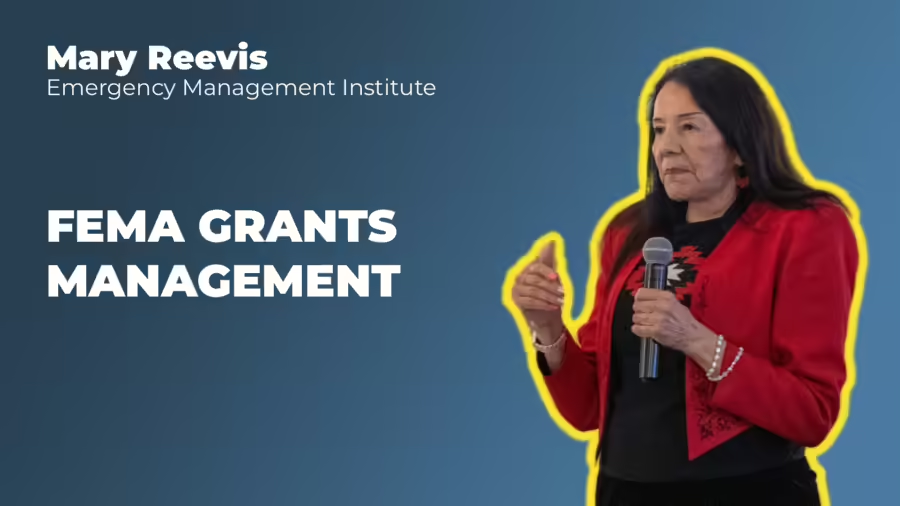
Mary Reevis | Emergency Management Institute
Mary Reevis is the National Tribal Training Specialist at FEMA’s Emergency Management Institute (EMI) in Emmitsburg, MD. Prior to joining EMI in late 2021, she worked as a trainer for 13 years at the Northern Rockies Training Center. She has a strong cultural background, in-depth emergency management experience, serves as a Training Specialist to Tribal Nations for emergency management courses, and is an enrolled member of the Blackfeet Tribe in Browning, MT.
This session facilitated learning about the grant management process for FEMA awards, from pre-award to closeout. An overview of the Fundamentals of Grants Management from the EMI 705 course was provided, including steps to improve the ability of FEMA grantees to administer federal grant funding.
Resources:
Addressing wildfire in your Hazard Mitigation Plans
Doug Green | Headwaters Economics
Doug manages Headwaters Economics’ Community Assistance for Wildfire program that has helped more than 80 communities across the country increase their wildfire resilience. With more than 25 years of professional experience in fire departments and as a land use planner, Doug brings practical insights to communities working to reduce risks from wildfires. Over the course of his career, Doug has provided training on structure and landscape wildfire risk assessments for fire personnel, land use planners, community leaders, and other trainers.
A well-crafted Hazard Mitigation Plan can unlock federal funding, bring together community members, and serve as a roadmap for important projects. This session included strategies for linking Hazard Mitigation Plans with other community plans—including Community Wildfire Protection Plans; best practices for reducing wildfire risk to structures; and bringing traditional knowledge into plans.
Resources:
Emergency managers panel
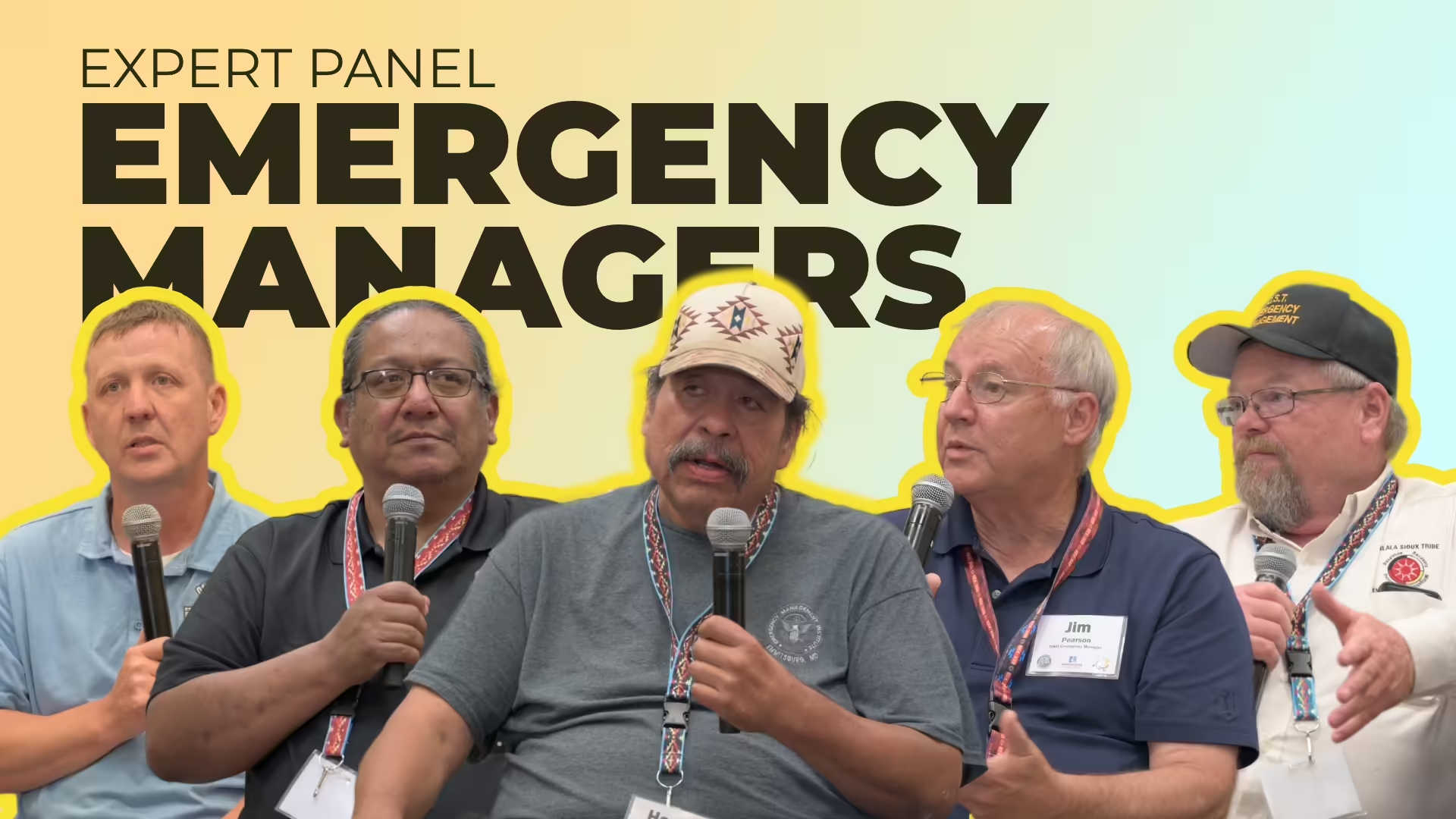
During this panel discussion, Tribal Emergency Managers came together to discuss topics affecting emergency response and preparedness on tribal lands. The session was interactive, with audience questions and discussion related to critical tribal emergency management topics like emergency management, resource allocation, and community resilience.
Panel highlights
- Distribution and use of toolsets
- The importance of volunteer organizations
- Challenges in obtaining response equipment due to limited budgets
- The need for coalition building among tribal emergency managers to amplify their voice to government entities
- The importance of traditional knowledge and cultural preservation
- The need for community self-sufficiency through initiatives like food sovereignty and internal support
The panel concluded with a call for unity and collaboration among tribes to address common challenges and to sustain cultural and environmental resources.

Host organization contributions to the Summit were made possible by generous support from Indian Health Service (IHS Cooperative Agreement U1B1IHS0007), USDA Forest Service, Margaret A. Cargill Philanthropies, and Feeding America Natives Prepared Project.