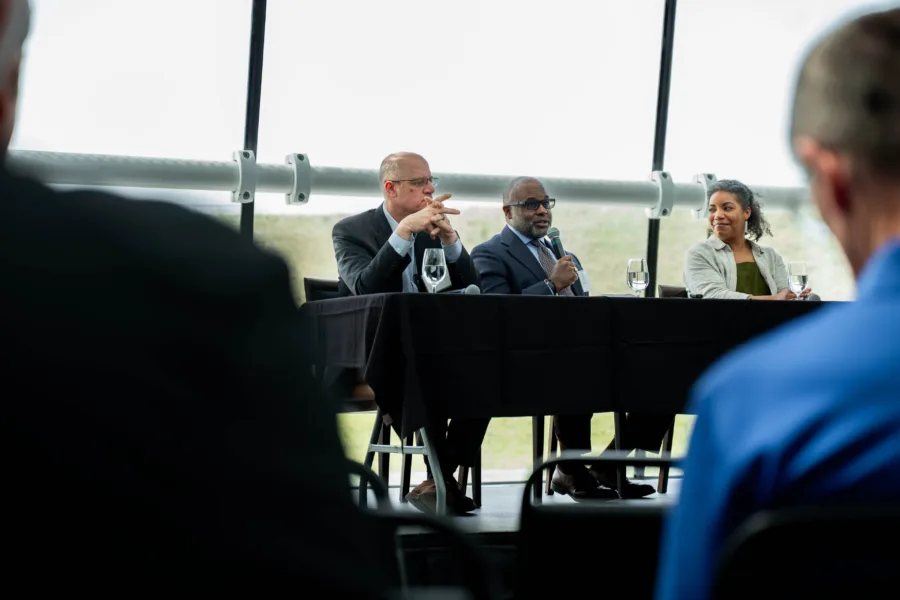
The State of Disaster Recovery in Rural America: A Candid Expert Conversation
April 6-7, 2026 | First Americans Museum, Oklahoma City, OK
Live presentation and Q&A · Hosted by Margaret A. Cargill Philanthropies, Center for Disaster Philanthropies, and Headwaters Economics · MACP Convening
Session overview
Opening with the story of Forsyth, Montana — a 1,600-person town on the Yellowstone River that spent $30,000 to compete for flood mitigation funding, was selected, then saw the federal funding canceled — this session explores why rural communities are systematically underserved by disaster programs. Researchers, practitioners, and policy experts examined structural barriers, emerging local innovations, and the urgent case for reform at the intersection of philanthropy, public policy, and community resilience.
Panelists
- Patty Hernandez | Moderator & Presenter
Executive Director, Headwaters Economics - Dr. Nnenia Campbell
Executive Director, Bill Anderson Fund
Research Associate, Natural Hazard Center, UC Boulder - Dr. John Cooper
Professor of Practice in Landscape Architecture & Urban Planning, Texas A&M University - Tony Pipa
Senior Fellow, Brookings Institution Center for Sustainable Development · Reimagining Rural Policy Initiative
Three economic lenses for the moment
Patty framed the session around three economic concepts: creative destruction (disruption can open space for innovation that wouldn’t otherwise emerge), the last-mile predicament (rural communities and the nonprofits serving them are essential infrastructure), and comparative advantage (government, philanthropy, and local organizations each have distinct strengths that work best when deliberately combined rather than duplicated).
Q&A highlights
Can every rural town realistically recover?
Panelists agreed that decisions about whether to stay or relocate must come from within communities, shaped by local leadership, civic will, markets, and the depth of place attachment. Forced relocation carries its own trauma; the need for intentional, community-controlled transition planning was emphasized.
Where do communities turn when they lack internal expertise?
Resources cited included land-grant university service programs, community and place-based foundations, state emergency management agencies, peer networks, and intermediary non-governmental organizations. Attendees also connected in real time with Oklahoma disaster service providers.
What about communities hit by repeated disasters?
Recovery must incorporate forward-looking resilience standards rather than just rebuilding to pre-disaster conditions. Eastern Kentucky’s experience — rebuilding on higher ground after repeated flooding — was cited as a model.
How do we sustain the organizations doing this work?
Participants raised alarm about aging volunteer networks, funding delays, and rising expectations on organizations already stretched past capacity. Panelists called for philanthropy to fund organizational capacity — not just disaster response.
Closing through lines
Each panelist called for action across four areas: advocacy (rural disaster impact must be made known to decision makers), cross-sector partnership (insurers, employers, and universities alongside nonprofits and government), organizational durability (the social infrastructure enabling relief must be sustained, not just funded per event), and next-generation investment (bringing youth into disaster research and practice intentionally).
Suggested Reading: Disaster Recovery in Rural America
Compiled for the 2026 MACP Rural Convening — The State of Disaster Recovery in Rural America, April 6–7, Oklahoma City, OK
1. Risk and Rurality, Part I: The Scope of the Challenge
Andrew Rumbach. Place + Resilience (Substack), March 2026.
Using USDA Rural-Urban Continuum Codes and FEMA’s National Risk Index, Rumbach shows that per-capita disaster risk increases as communities become more rural — reaching more than double the metropolitan rate in the most remote counties — and maps where agricultural losses are most concentrated.
2. Rethinking Our Assumptions and Financing Tools for Community Resilience
Matt Posner and Xavier de Souza Briggs. Brookings Institution, September 2025.
Argues that one-time grant funding for resilience has failed cash-strapped communities, which face new extreme weather events before recovering from the last one. Examines innovative financing models suited to small, rural, and low-resource places that cannot wait for federal reform.
3. Getting Rural Recovery from Hurricane Helene Right
Tony Pipa and Matt Calabria. Brookings Institution, September 2025.
Convening panelist Tony Pipa interviews North Carolina’s state recovery director after Hurricane Helene, exploring how rural communities face compounding pre-existing challenges, how multi-agency federal funding streams create coordination burdens, and what streamlined rural-focused recovery systems could look like.
4. Mapping Rural Local Government Capacity for Climate Resilience Projects in the United States
Kristin Smith, Erica Goto, Simone Domingue, Scott Kalafatis, Meridith Bartley, Tara Preston, and Patricia Hernandez, et al. Public Administration Review, August 2025.
Introduces a national Rural Capacity Index and demonstrates a significant relationship between a community’s capacity score and its success in securing competitive federal grants — finding that a 1% increase in the index is associated with a 4% increase in awards, with the Midwest showing the most severe gaps.
5. Get Rid of FEMA? Some States Will Hurt More Than Others.
Sarah Labowitz and Debbra Goh. Carnegie Endowment for International Peace, March 2025.
Using the Carnegie Disaster Dollar Database, the authors quantify what states stand to lose if federal disaster programs are dramatically reduced — finding Gulf South and mid-Atlantic states most exposed, with rural communities bearing a disproportionate share of unmet need.
6. Advancing Rural Disaster Philanthropy: Barriers and Opportunities
Center for Disaster Philanthropy, 2024.
Examines the structural barriers that prevent philanthropic dollars from reaching rural communities after disasters, and offers guidance for funders seeking to direct resources more equitably toward places with the fewest reserves and the highest need.
7. How FEMA Can Build Rural Resilience Through Disaster Preparedness
Kevin Manuele and Mark Haggerty. Center for American Progress, October 2022.
Documents how rural communities have been largely locked out of FEMA’s competitive pre-disaster mitigation grants due to capacity constraints — fewer than 10% of nationally competitive BRIC proposals received funding, with most dollars flowing to wealthier states — and offers concrete recommendations for more equitable program design.
8. Assessing the Quality of Rural Hazard Mitigation Plans in the Southeastern United States
Jennifer Horney, Mai Nguyen, David Salvesen, Caroline Dwyer, John Cooper, and Philip Berke. Journal of Planning Education and Research, 37(1), 2016.
Scores hazard mitigation plans across 84 rural counties in eight southeastern states and finds overall quality to be poor — particularly in goals, fact base, and public participation. Key informant interviews reveal how limited staffing and resources leave rural counties least able to produce the very plans that would help them access federal mitigation funding.
9. Looking Through Different Filters: Culture and Bureaucracy in the Aftermath of Disaster
Nnenia Campbell. Natural Hazards Center, University of Colorado Boulder, 2016.
Drawing on the 2013 Colorado floods and small mountain communities, Campbell documents how command-and-control disaster response by large outside organizations — however well-intentioned — conflicts with rural communities’ deep values of self-reliance and autonomy, eroding local capacity rather than building it. A direct argument for locally-led recovery.
10. Weathering the Storm: The Role of Local Nonprofits in the Hurricane Katrina Relief Effort
Tony Pipa. Aspen Institute, June 2006.
A foundational report finding that small and medium-sized nonprofits and faith-based organizations were at the heart of Katrina’s disaster response, largely overlooked by national media. It makes the case for shifting philanthropic giving to the local level and investing in the operating capacity of community organizations.
Subscribe to our newsletter!
