Headwaters Economics examined a wide range of public lands uses, including mining and agriculture, but focused on recreation because this type of use represents the largest, most complex, and least well understood activity on public lands in the county.
This report updates an earlier October 2011 study commissioned at the request of a number of local interests, businesses, and local officials—to help inform discussions about how to develop, protect, and manage nearby public lands so that they benefit local companies, the county, and diverse users into the future.
The update has two broad goals. First, it analyzes Grand County’s economy in light of the ongoing recovery from the Great Recession. Second, Grand County has a history of working to balance recreational and energy uses on public lands. New proposals—ranging from whether to further increase the recreation and tourism sector, encourage energy development, or emphasize other economic opportunities—should be considered in light of the current economy’s performance and opportunities for sustainable future growth.
Summary
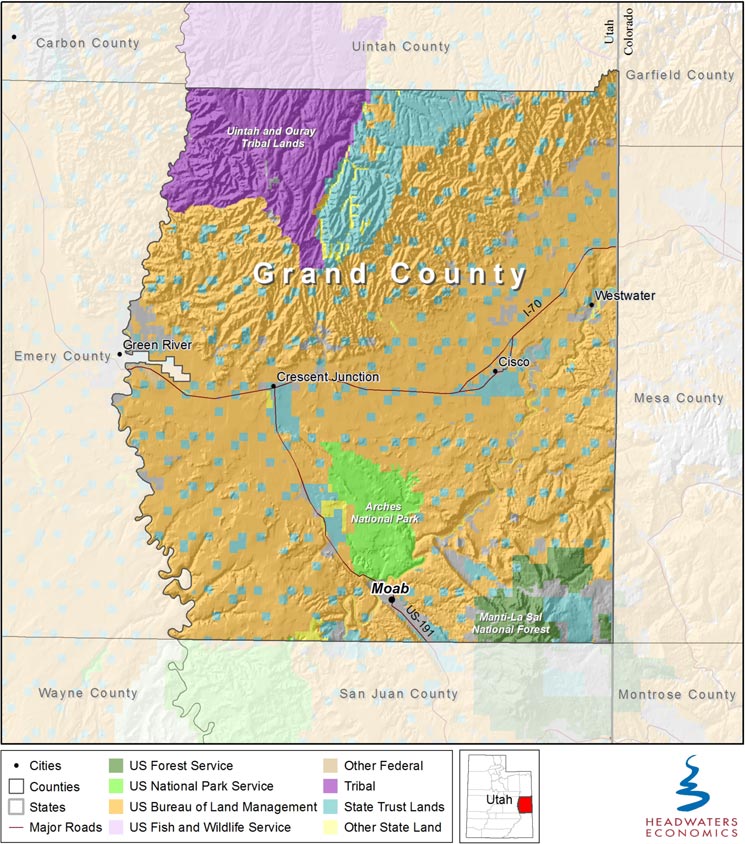
Grand County consists largely of public lands—87 percent of the county is a mix of state and federal lands managed by different agencies for a range of users and purposes. Management of these extensive lands is important to local businesses because of the close tie between public lands resources and local economic activity.
Land Ownership by Type, 2012
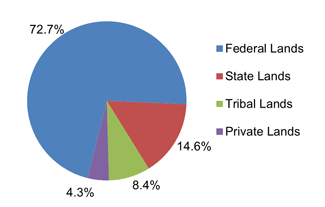
Source: U.S. Geological Survey, Gap Analysis Program. 2012. Protected Areas Database of the United States (PADUS) version 1.3.
The economic and revenue importance of the travel, tourism, and recreation has increased in Grand County during the past several years. Today, the travel and tourism sector is the largest employer, and businesses operating in these areas are the main drivers of the local economy—accounting for 47 percent private employment in the county.
Looking at federal public lands specifically, a 2007 analysis shows that area BLM lands supported 2,447 direct jobs that year. For the National Park Service, the agency’s economic modeling shows that area national parks supported 2,103 direct jobs in 2013. (Note: these data should not be added together.) To put this in perspective, the U.S. Department of Commerce reports that in 2013 there were 7,143 total jobs in Grand County in 2013.
Today, more than 1/3 of families have a member that works in a tourism and recreation business related to public lands, and nearly 2/3 of local residents indicate that public lands are “extremely important” to their business.
National Park Visitation, Arches and Canyonlands
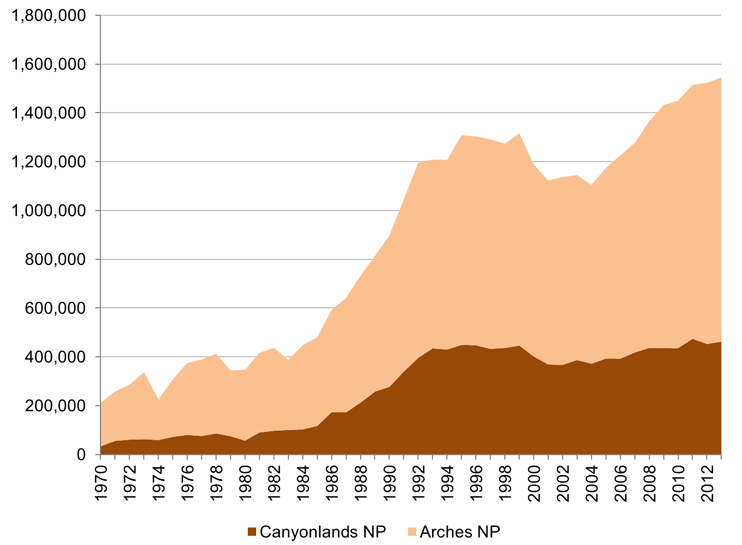
Source: U.S. Department of the Interior. 2014. National Park Service. Natural Resource Program Center. Economic Benefits to Local Communities from National Park Visitation and Payroll.
New employment growth is not just tied to the tourism and recreation sectors. Grand County’s picturesque and high-profile public lands—and the environmental and recreational amenities they provide—are closely linked to population growth and other economic benefits. From 2001 to 2013, Grand County employment in finance and insurance (+61%), health care (+56%), and professional and technical services (+32%), for example, all grew faster than the overall increase in employment (+25%).
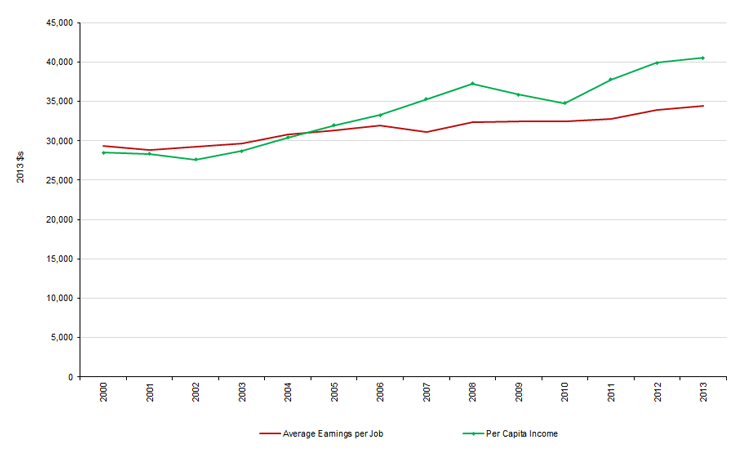
At the same time, real earnings per job stabilized ($34,429 in 2013 compared to $27,866 in 2009), and per capita income rose, in real terms, from $30,333 in 2009 to $40,545 in 2013. Non-labor income, much of it retirement related, grew by more than 77 percent, or nearly $77 million new dollars, in real terms, from 2000 to 2013—which helped increase per capita income while providing stability to the local economy and stimulating health care, construction, and other sectors.
Average Earnings Per Job & Per Capita Income, Grand County, Utah
Source: U.S. Department of Commerce. 2014. Bureau of Economic Analysis, Regional Economic Accounts.
During the second half of the 20th century, mining activities played a significant role in the region’s economy. Since peaking in 1981, however, the share of Grand County residents employed in mining fell rapidly and plateaued at 2 to 3 percent of total employment for the past 15 years. This sector’s employment share dropped slightly since our last study in 2011.
Employment in Mining, Share of Total and Details, 2012
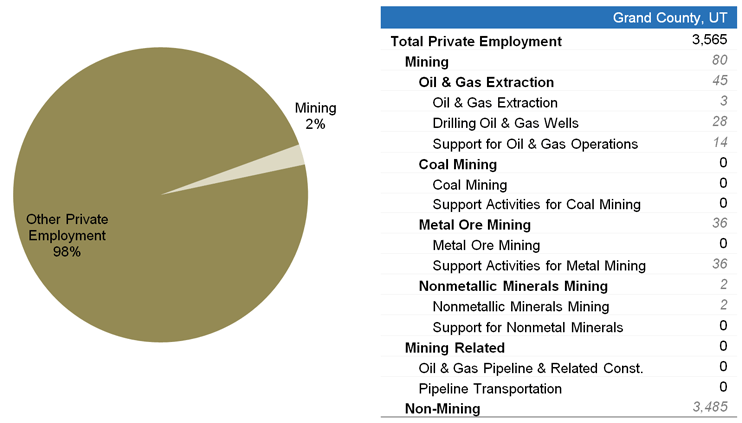
Source: U.S. Department of Commerce. 2014. Census Bureau, County Business Patterns. This table does not include employment data for government, agriculture, railroads, or the self-employed because these are not reported by County Business Patterns. Estimates for data that were not disclosed are shown in italics.
Looking at local government tax revenue, travel, tourism, and recreation produced roughly 18 percent of local government taxes in 2013; while natural resources increased somewhat to roughly ten percent that same year.
A significant reason for the county’s economic success stems from the diversity found within its tourism and recreation economy and the large diversity of activities that nearby public lands support. This diversity attracts both visitors and new residents. Finding ways to sustain and develop tourism and recreation that appeals to a wide mixture of visitors and residents is paramount to long-term well-being and economic resilience.
Average Increase in Per Capita Income from Protected Public Lands,
Non-Metro West, 2010
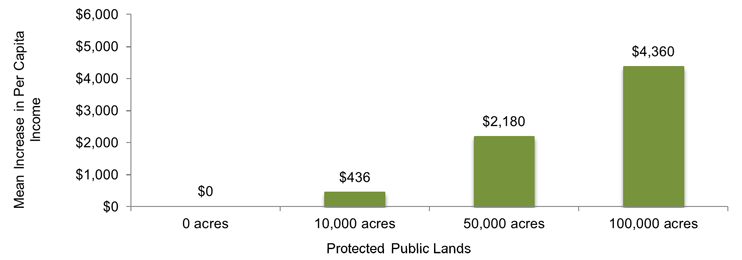
Source: Rasker, R., P.H. Gude, M. Delorey. 2013. The Effect of Protected Federal Lands on Economic Prosperity in the Non-Metropolitan West. Journal of Regional Analysis and Policy.
Discussion
The public lands in Grand County—because of their extensiveness, mineral richness, and beauty—directly influence, shape, and support the county’s economy. They are a competitive advantage for the region’s economy and will play a vital role in the future economic health and prosperity of the region.
Despite past success, future growth in Grand County cannot be taken for granted. The boom years of the 1990s when the county’s economy grew by 7 percent annually have yielded, in the 2000s, to an economic growth rate of 2 percent annually.
A key challenge facing Grand County leaders is how to maximize the long-term return from this valuable asset. To continue to capitalize on the competitive advantage that these lands provide, the county and local groups should work collaboratively with state and federal officials to implement policies that sustain existing uses and also anticipate future development and protection needs to provide for a long-term economic return.
Specific tourism and recreation issues to consider include:
- How to best accommodate different users so they do not crowd each other out and diminish one another’s experience—which could drive away visitors or create the impression that the county favors one form of recreation;
- How to sustain the quality, diversity, and uniqueness of the outdoor landscape and recreational offerings; and,
- How to compete with rival destinations in the outdoor recreation market that have constructed new signature trail systems or are benefiting from newly created public lands protections.
To help ensure Grand County’s future economic health, several steps are worthy of consideration:
- Educate the public to better understand the important economic role that public lands play in Grand County, including a periodic update on the county’s economic health and trends—especially focused on tourism and recreation, but including all core sectors;
- Partner closely with public land managers on planning and decisions that impact public lands in Grand County, including funding to maximize protection and access to public lands;
- Utilize the national and international visibility created by public lands and recreation—such as national parks, the Colorado River, mountain biking, and jeep events—to attract visitors, entrepreneurs, or retirees who bring new businesses and wealth to the region;
- Work with local businesses as well as local, state, and federal officials to make sure that uses on public lands do not crowd out or harm existing economic benefits; and,
- Build on the region’s high quality of life by providing other assets—such as expanded education and training, more housing, and increased airport service—to retain or grow local businesses while increasing the county’s attractiveness to new businesses and investments.
Map
Land Ownership in Grand County, Utah